
Deon Green didn’t aim to be a top producer, but Northmarq helped him become one
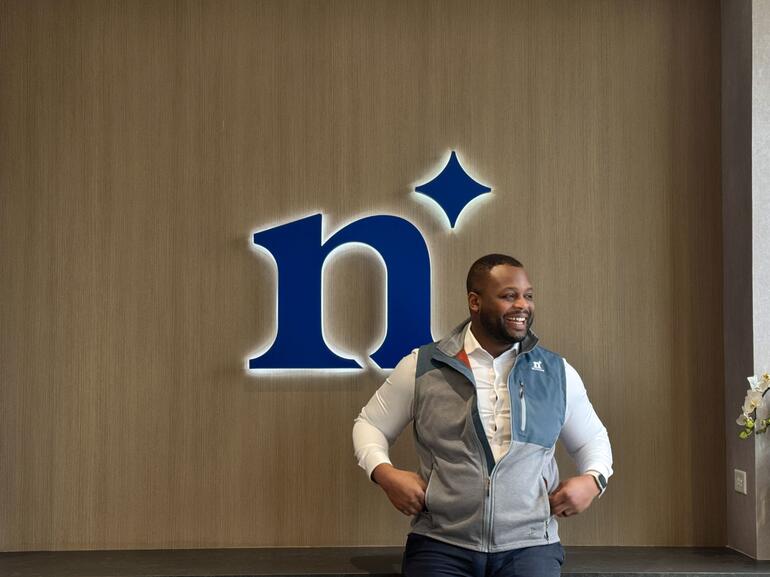
On most mornings, before the first call of the day, Deon Green has already done his preparation.
He starts with 30 minutes of quiet reflection, then turns to the news — CoStar, The Real Deal, The Dallas Morning News, Bisnow. By the time a client joins the line, he has a working sense of where capital is tightening, where lenders are stretching and what conversations may need to happen before numbers are even discussed.
On a call, he can usually spot the issue before it is voiced. He knows how an agency credit team will view a deal, where leverage will stop, when a structure will hold and when it won’t.
He used to sit on the other side of those conversations.
Today, as a vice president, he originates debt and arranges equity at Northmarq’s Dallas office, working primarily on multifamily transactions nationwide. In 2025, he closed more than $45.6 million in total transaction volume. Every step of his professional career, from intern to producer, has taken place inside Northmarq.
It wasn’t the path he originally planned.
Before Northmarq
Real estate was part of Green’s childhood, but it was not part of his plan.
He grew up in South Carolina around open houses and mortgage conversations. His father worked in residential sales. His grandfather was in lending. The industry was familiar — steady, present, almost background noise.
But familiarity does not always translate into ambition.
At the University of South Carolina, football and finance felt like a clearer direction. He liked numbers. He liked structure. Finance offered the promise of logic: inputs, outputs, results.
“I was always good at math,” he said, remembering how investment banking first caught his attention. There were movies that made the industry look sharp and decisive. Banking seemed measurable. Predictable. A ladder you could see from the bottom.
It felt cleaner than commission sales. More defined on paper.
Then he graduated and realized clarity does not arrive just because you earn a degree.
The SMU effect
He moved to Dallas for graduate school at SMU, determined to define the direction that had felt blurry after graduation.
Instead, it changed the questions he was asking.
SMU carries weight in Dallas real estate circles. The Cox School of Business and the Folsom Institute for Real Estate have produced a significant share of the city’s commercial real estate leadership, including Northmarq Capital Markets President Jeffrey Erxleben.
He wasn’t curious about job openings yet. He was curious about how commercial real estate worked. How a deal moved from idea to execution. How capital was sourced. How firms were built.
So, he started asking questions.
Coffee with alumni. Conversations with executives. Questions about the early years, especially the uncertain ones when careers are not yet defined.
One of those conversations was with Erxleben and the late Bill Jackson, both former SMU athletes who had built careers in the same industry Green was still trying to understand.
“I’ll say they were pretty convincing,” he said. “Bill Jackson had a huge personality. And Jeff is Jeff. If you sit down with Jeff, you leave the room fired up.”
It wasn’t just what they said. It was what they represented. They had been in his seat — former athletes navigating the shift from structured competition to a business where performance looked different but mattered just as much.
At one point, Erxleben looked at him and asked, “You ready?”
“Ready for what?” Green remembers thinking.
“We’ll bring you on, man.”
That was it.
His first internship. His first exposure to corporate America. No extended deliberation. No five-year plan. Just an opportunity — and a decision to take it.
The internship
Green joined Northmarq as a production intern.
From 8 a.m. to 4 p.m., he was in the Dallas office. From 6 to 10 p.m., he worked at the Apple Store.
It was post-grad. He had his master’s degree. He had never had an internship before.
During the day, he sat inside production conversations that, until then, had been abstract. He watched how deals were positioned before they were ever sized. He listened as producers discussed structure and capital sources in the same breath. It was his first exposure to how financing came together from multiple angles, not just how it was evaluated.
No one handed him a roadmap. He asked questions. He stayed engaged. He tried to understand what the people around him understood.
That curiosity followed him.
At Northmarq, the internship experience is designed to go beyond observation. Interns are given structured exposure to the business through formal training, mentorship and direct interaction with leaders across the firm.
“We want them to understand not just what we do, but how the business works as a whole,” said Kim Breck, Northmarq’s director of talent and development. “That means combining hands-on experience with training, mentorship and access to people across the platform.”
At the end of 2017, Jay Donaldson brought Green onto the Agency team full time as a DUS underwriting analyst, his first permanent role in the industry. Northmarq’s president of Agency and FHA Finance saw the competitive discipline early.
“Deon is wired to compete, but he’s just as wired to support the people around him,” Donaldson said.
Learning the guide
Underwriting gave Green discipline.
“I learned a lot,” he said. “I really developed expertise in Fannie Mae credit underwriting — understanding cash flow, understanding the guide and knowing what fits inside a Fannie Mae loan.”
He learned how credit committees think. How assumptions are stress-tested. How small details can change the outcome of a deal. He learned the boundaries — what qualifies, what doesn’t and why.
Mastering those rules sharpened him.
But it also pushed him to ask bigger questions.
“If you know Agency deals, Fannie and Freddie are pretty similar,” he said. “I moved into production because I wanted to learn the entire capital stack.”
He kept coming back to the same question: if Fannie Mae wasn’t winning the business, who was, and what made the difference?
Eventually, the question became a decision.
He didn’t wait to be asked.
Back across the table
By 2023, after several years in underwriting and an investment analyst role, Green was ready to move into production.
When he asked to move back into production, leadership didn’t redirect him. They engaged him.
“My transition was strongly supported by Stephanie Studer and Jay Donaldson on the Agency side, along with Jeff Erxleben and Lauren Bresky on the production side,” Green said. “Having leadership aligned across both teams made the move intentional and strategic, not just positional.”
Donaldson had seen the progression up close, from intern to analyst to producer.
“You could see the transition from his football career into this business early on,” Donaldson said. “He prepares. He shows up for his team. And he wants to win, not just for himself but for his clients.”
That mindset would be tested almost immediately.
In 2023 and 2024, the market turned. Acquisitions slowed. Refinances stalled under the weight of rising interest rates.
He did not originate a single deal in his first two years of production.
For many young producers, that would have been a short tenure.
It wasn’t.
Northmarq stayed in his corner. The feedback continued. The support did not disappear when the volume did.
That consistency is tied to how the firm is structured.
Because Northmarq is privately held, it operates with a longer-term view — one that isn’t driven by quarterly earnings cycles. During the market downturn in 2023 and 2024, when some firms pulled back on support roles, Northmarq maintained its teams and infrastructure.
“There’s a long-term mindset here,” said Jeff Lichner, vice president of mergers and acquisitions. “You’re not managing to the next quarter. You’re building something that lasts, and that shows up in how teams are supported, especially in tougher markets.”
It’s a path Northmarq has made intentional, allowing analysts to develop expertise before stepping into production with built-in support.
There’s also an expectation that success isn’t built alone. “We don’t operate in a way where teams compete against each other internally,” Lichner said. “If something doesn’t fit how we work together, we don’t force it. The focus is on collaboration and long-term relationships.”
That structure extends into early career development. Through Northmarq’s associate program, analysts are paired with experienced producers. They gain exposure to day-to-day deal activity while building their own understanding of the business.
“It’s not just training in a classroom setting,” Breck said. “They’re learning alongside producers, seeing how deals come together and building relationships across the platform from the start.”
Green wasn’t navigating it alone. Around him were others on similar trajectories, including Mason Brower, who began on a different underwriting track before the two stepped into associate producer roles at the same time.
“We’ve had almost the same path,” Brower said. “Different analyst roles, but we moved into production together. It’s a common path here, but you still have to take it.”
In Northmarq’s Dallas office, walking meetings have become something of a tradition — a way for teammates to step away from their desks, think out loud and pressure-test ideas in motion. Green and Brower have kept that habit — using those walks to work through deals, market shifts and the realities of growing into production.
Brower describes Green as someone who is consistently in your corner, whether it’s stepping in on a transaction or talking through something bigger than work.
“If I have a question about agencies, he’s my go-to,” Brower said. “He knows that side inside and out. But he’s also done a good job rounding out the rest of the business.”
That support mattered, especially during the stretch when deals weren’t closing.
When the market began to move again, Green was ready. The groundwork had already been laid — relationships built, knowledge sharpened, perspective gained.
Looking back, he resists comparing timelines.
“Everyone has a different path,” he said, borrowing a line he often repeats with Brower. “Comparison is the theft of joy.”
When asked what season shaped him most, he doesn’t point to awards or production goals.
He points back to the stretch when he was balancing Northmarq and the Apple Store.
“I reflect on that season often,” he said. “When you’re in the grind, it’s easy to forget the goals you’ve already accomplished. I’d tell the younger me to believe in his skill set and push confidently for what he wants. The foundation was being built, even if the results weren’t immediate.”
He pauses, then adds something quieter.
“And I think he’d remind me to stay positive and patient. Every goal, obstacle and breakthrough takes time.”
At Northmarq, growth isn’t automatic. It requires initiative. But for those willing to raise their hand and do the work, there are people in the room who will help you build it.
“The foundation was being built,” Green said. “Even if I couldn’t see it yet.”
Learn more
Watch the video on YouTube!
Northmarq is one of the largest privately held commercial real estate firms in the United States, combining a nationwide presence with deep local expertise. With more than 50 offices across the country, we provide a full suite of debt, equity, investment sales, loan servicing and fund management solutions for a comprehensive range of property types. Our unique structure allows us to connect clients with the best opportunities, yet be nimble enough to ensure access to every expert across our company. The firm manages a loan servicing portfolio of over $80 billion and has completed $91.3 billion in transactions over the past four years. At Northmarq, collaboration fuels results, helping clients achieve success in every market, nationwide.