
Understanding 100% bonus depreciation: Strategies for maximizing tax benefits through car wash, convenience store and other net lease investments
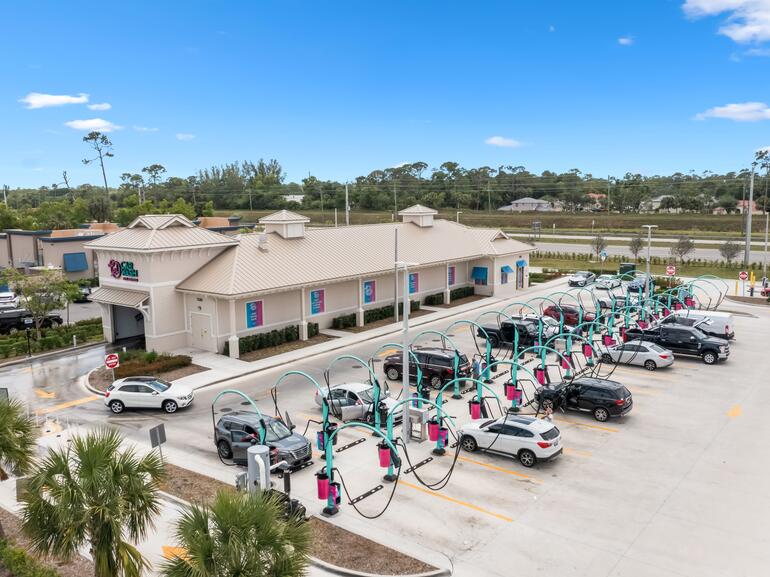
On July 4, 2025, President Trump signed the One Big Beautiful Bill Act (OBBBA) into law. This was an impactful development for commercial real estate investors seeking to maximize tax benefits through real estate purchases. Chief among the OBBBA’s provisions related to commercial real estate is the reinstatement of 100% bonus depreciation, a powerful tax incentive last in place at the 100% threshold from 2017 to 2022.
Car wash, convenience store (c-store) and gas station investment properties benefit in an outsized way from 100% bonus depreciation’s return. But many other property types are also eligible for 100% bonus depreciation in varying ways.
Jim Ceresnak, vice president at Northmarq with a specialization in car wash properties, and Amar Goli, managing director at Northmarq with vast experience in the c-store and gas station vertical, among other sectors, joined Alex Smith of Patapsco Corporate Services, also known as “The Car Wash CPA” and Sean Lichterman, a cost segregation specialist at Capstan Tax Strategies, to explore this topic further.
How has the market for car wash and c-store/gas station investment properties changed since the passage of the OBBBA? Have you seen an uptick in demand?
Jim Ceresnak: In just the few weeks since the OBBBA’s passing, we have seen a dramatic increase in demand for net lease car wash properties. This is already having an impact on cap rates with the overall cap rate spectrum trending lower.
We are now seeing high-quality deals consistently fetching cap rates in the low 6% cap rate range, and all deals have experienced some level of cap rate compression as demand has picked up.
Broadly, I would say that the return of 100% bonus depreciation has driven a 25-basis-point decrease in car wash cap rates overall, with deals trading in a general range of 6.25% to 7.25%, with the highest-quality deals trading even lower. We expect elevated demand through the end of 2025, and that demand will be supercharged if we see interest rates come down in any meaningful way.
Amar Goli: I would echo Jim’s comments that we have seen an increase in demand for c-store properties, as well as other net lease properties that can benefit from 100% bonus depreciation. We work with several clients who are repeat buyers of depreciation-advantaged properties, and many are actively pursuing deals to take advantage of these boosted tax incentives in 2025. In addition, there are several new buyers that have entered the market that had previously been on the sidelines when bonus depreciation had stepped down to 80% and 60% respectively in 2023 and 2024.
The passage of the OBBBA is a huge tailwind for the net lease property sector in general, and we expect to see a significant increase in deal flow and transactions in the months ahead. Again, transaction activity will only increase further if the debt landscape improves.
Securing favorable debt remains a challenge for many would-be buyers. But we have started to see things improve on that front in the last few weeks as well.
How can car wash and c-store/gas station investors best take advantage of 100% bonus depreciation?
Alex Smith: Car washes, convenience stores and gas stations are equipment and mechanical intensive and are not strictly a building with land like an office complex. This creates a significant opportunity for reclassification of the purchase and improvements across multiple asset classes which allow for bonus depreciation due to their short life asset classes. This takes an investment that would take 39 years to depreciate down to 5, 7 or 15 years, realizing a tremendous tax benefit in the early years of ownership where the value of that asset is more closely aligned to its real lifespan.
Sean Lichterman: Car washes and c-store/gas station properties are uniquely well-positioned to benefit from 100% bonus depreciation, particularly due to the favorable classification guidelines outlined in the IRS Audit Technique Guides.
For car washes, if the facility is a self-serve or tunnel-style operation without retail onsite, the IRS allows the entire property to be classified as 15-year property under Asset Class 15G, rather than the standard 39-year commercial building classification. This includes the building, site improvements (e.g., paving, curbing, drainage) and all personal property (equipment, controls, signage, etc.), making 100% of the asset potentially eligible for bonus depreciation under the OBBBA, provided it’s acquired and placed in service after January 20, 2025.
Similarly, convenience stores with gas stations will qualify for 15-year treatment if they meet any of the three following IRS criteria:
- More than 50% of gross revenues must be derived from petroleum sales (fuel)
- More than 50% of the square footage must be dedicated to fueling-related activities, such as canopies, pump areas, and tank infrastructure
- The c-store building is 1,400 square feet or less, regardless of whether it meets either of the previous criteria
These classifications allow for the full expensing of eligible assets in the first year under the reinstated 100% bonus depreciation provision.
These asset types are ideal candidates for accelerated depreciation strategies because they’re asset-heavy, with a large proportion of property eligible for shorter tax lives. Through a comprehensive cost segregation study, we can typically reclassify 60% to 100% of total basis into 5-, 7- or 15-year property, qualifying it for immediate expensing under the OBBBA.
The key for investors is to engage a qualified cost segregation specialist as early as possible, especially when developing, acquiring or significantly renovating these properties. Early analysis ensures optimal property classification, maximizes year-one deductions and supports long-term cash flow planning for both institutional and owner-operator stakeholders.
How can using 100% bonus depreciation help boost overall investment returns?
Alex: Bonus depreciation is a key tax strategy to accelerate depreciation into multiple asset classes instead of the default 39-year. By accelerating depreciation during the immediate year of purchase, investors create a large tax benefit that can offset taxable profit from the investment and carry forward any unused depreciation indefinitely into future years, depending upon each investor’s overall tax situation.
It is not uncommon for an investor to realize multi-year tax savings. Further, the realizable tax savings due to accelerated depreciation can and should be factored into the overall financial performance of each investment. Being able to realize a six-figure or more tax savings is a significant boost to cash flow.
Sean: 100% bonus depreciation provides a powerful timing advantage that can significantly enhance an investor’s after-tax returns. By front-loading depreciation deductions into the first year of ownership, investors are able to substantially reduce taxable income during the most critical phase of an investment’s lifecycle.
This accelerated deduction results in greater after-tax cash flow early on, which can be strategically reinvested, used to service debt, or improve liquidity – all of which contribute to enhancing internal rate of return (IRR). While depreciation itself is a non-cash expense, the tax savings it generates can have a very real and positive impact on project-level economics.
When structured properly, these accelerated losses can also be used to offset passive income from other investments or generate net operating losses (NOLs) that may be carried forward to offset future gains. In many cases, this creates a compounding effect: more cash retained upfront, more capital to deploy and more flexibility in portfolio-level tax planning.
In short, bonus depreciation is more than just a tax deferral strategy – it’s a tool that can materially improve the net yield and overall return profile of a real estate investment.
What should investors be concerned with when evaluating an investment to take advantage of 100% bonus depreciation? Are there any pitfalls?
Sean: Yes, while 100% bonus depreciation is a powerful tool, there are several important considerations and potential pitfalls investors should be aware of:
- Eligibility and property use requirements: Certain property types must meet strict criteria to qualify for accelerated treatment. For instance, convenience stores with fuel sales must derive more than 50% of gross revenue from petroleum sales to be classified as 15-year property under IRS Asset Class 15G. If a property falls short – due to food service, retail or car wash revenue dominating the income mix – only a portion of the asset may qualify, reducing the available bonus depreciation benefit.
- Improper basis allocation: Depreciation can only be applied to the depreciable basis of a property (i.e., everything except land). If the purchase price allocation between land, building and site improvements is inaccurate – whether due to aggressive land undervaluation or overstatement – this can trigger audit risk or reduce the depreciation benefits. A professional cost segregation study helps ensure that allocations are defensible and optimized.
- Hold period and depreciation recapture: While front-loading deductions provides cash flow advantages, those gains can be offset if the property is sold too quickly. Bonus depreciation is subject to recapture tax, meaning much of the accelerated benefit must be paid back upon sale unless mitigated by strategies like a 1031 exchange. For short-term holds or flips, this could negate much of the initial tax advantage.
- Working with inexperienced advisors: The application of bonus depreciation requires precise property classification and documentation. Missteps – such as misidentifying eligible components, skipping a segregation study or failing to substantiate cost breakdowns – can result in lost deductions or IRS scrutiny. Investors should engage experienced cost segregation professionals and tax advisors to ensure compliance and full optimization.
In short, while bonus depreciation can be a game-changer, investors need to approach it with strategic intent, proper due diligence and expert guidance to avoid costly missteps and fully unlock its benefits.
Alex: When we talk with investors considering properties, the first thing I am looking to determine is what provisions in the tax code will allow them to utilize the tax savings this year and in future years.
It’s impossible to deduce the nuances for every single tax situation, but I am always looking to determine what will allow them to deduct potentially passive-in-nature losses. For instance, are they (or a spouse) currently actively involved in real estate and real estate investments? What income sources are they trying to offset? How much money are they going into the project with, and what will their expected basis be?
The other major pitfall I am seeing more of is the value of the associated land relative to the purchase itself. States like New York, California and Colorado with high land values significantly impact the amount of depreciable basis of the overall asset. I now pull property records and assessments before an LOI or due diligence event begins so that we can proactively set depreciation expectations. A $1.5 million purchase with a $900,000 land allocation is a depreciation heartbreak, and it’s unfortunately becoming more common as municipalities increase their tax base.
Do any other properties outside of car washes and c-stores qualify for 100% bonus depreciation?
Alex: All properties qualify for some amount of 100% bonus depreciation. It’s really the nature of the asset that will help determine the amount.
Properties that are mechanical and systems intensive will create the greatest benefit. A $750,000 single-family rental home will have some property eligible for bonus depreciation, but it will be far less than that of a $750,000 commercial property.
Multifamily apartments are another common asset class that benefits from bonus depreciation because the property will inherently have multiples of everything – HVAC systems, kitchen cabinets, flooring types – all of which have their own favorable depreciation rules.
Sean: 100% bonus depreciation is available to a wide range of commercial and residential investment properties, provided the assets are placed in service during the eligible time window and meet IRS requirements for depreciable life.
In addition to car washes and c-stores, qualifying property types include:
- Oil change/lube centers
- Fast food and quick-service restaurants (QSRs)
- Medical and dental offices
- Warehouse and industrial facilities
- Multifamily and single-family rental properties (both short- and long-term rentals)
- Retail buildouts and tenant improvements
Importantly, renovations, expansions and improvements to existing properties can also qualify if those assets are new to the taxpayer and meet the placed-in-service criteria.
Through cost segregation, significant portions of these properties can be reclassified into 5-, 7- or 15-year property, making them eligible for full expensing under 100% bonus depreciation rules.
This makes bonus depreciation a powerful strategy not only for new developments and acquisitions but also for existing owners looking to reinvest and optimize tax outcomes.
Is there a way for property owners who missed out on previous years’ depreciation to take advantage in the current year?
Sean: Yes, property owners who did not perform a cost segregation study in earlier years can still unlock those missed depreciation benefits through a process known as a “look-back” study.
The IRS allows for a catch-up adjustment using Form 3115 (Application for Change in Accounting Method), which includes a Section 481(a) adjustment. This mechanism enables owners to retroactively apply accelerated depreciation without needing to amend prior tax returns. Instead, all the missed depreciation from previous years is captured as a one-time deduction in the current tax year.
This strategy is especially valuable for long-term property holders who now have significant taxable income they’d like to offset – whether from operations, capital gains or other passive investments. It’s also a strong fit for newly acquired properties that were placed in service within the past few years but didn’t undergo a cost segregation study at the time.
In essence, this approach allows investors to recover missed opportunities and boost current-year cash flow, all while staying fully compliant with IRS procedures.
Are there any other provisions in the OBBBA that will benefit real estate investors going forward?
Sean: Beyond the reinstatement of 100% bonus depreciation, the OBBBA contains several pro-growth provisions that real estate investors and business owners can leverage to reduce tax liability and enhance after-tax returns.
One of the most notable additions is the creation of a new asset class called Qualified Production Property (QPP). This is designed to incentivize domestic investment in manufacturing, refining and production-related infrastructure, including buildouts and improvements. Real estate developers who build or retrofit facilities supporting these functions may benefit from accelerated depreciation under this new category.
Additional investor-friendly provisions and updates include:
- Doubling of Section 179 expensing limits: The bill expands Section 179’s expensing thresholds, allowing businesses to immediately deduct up to $2.5 million of qualifying capital expenditures, with a phaseout starting at $4 million in total asset purchases. This is especially impactful for smaller operators or developers completing tenant improvements or purchasing equipment-heavy facilities.
- Energy-efficient building incentives (179D energy efficient improvements): While not extended under the OBBBA, timing is critical to recoup additional deductions through energy efficient improvements. Under the OBBBA, 179D energy efficient deductions will sunset June 30, 2026.
- EV charger and solar credits: The bill includes sunset dates for these tax provisions as well to clean energy credits for electric vehicle (EV) charging infrastructure and solar installations, starting December 31, 2027.
These provisions can be strategically layered with cost segregation and bonus depreciation to maximize tax efficiency, especially for projects involving:
- Ground-up development
- Major retrofits or energy upgrades
- Asset repositioning for manufacturing or distribution
- Build-to-suit industrial or clean tech facilities
In short, the OBBBA expands the toolbox for real estate investors looking to enhance first year cash flow to reinvest for growth opportunities.
Alex: 100% depreciation is hands down the biggest benefit for real estate investors. Purely speculative, but I anticipate states to respond to the sunsetting of various federal EV and energy efficient improvements deductions with their own state-specific incentives.
I always advise clients to check with their state, as well as their utility provider, for grants and credits that drive energy improvements that will help offset renovation and improvement costs. These types of improvements typically qualify for 100% bonus depreciation.
How long will 100% bonus depreciation be in effect and what is the outlook for bonus depreciation-eligible net lease properties going forward?
Jim: The OBBBA extends 100% bonus depreciation eligibility through December 31, 2029. Bonus depreciation has been critical to the net lease car wash sector’s maturation into a highly investible and desirable asset class. We expect demand for car washes and other bonus depreciation-eligible net lease assets to remain high so long as these tax advantages are in place.
Get the report



Insights
Research to help you make knowledgeable investment decisions