
Retail reset: Where the next generation of net lease opportunity is taking shape
As new retail winners emerge and old assumptions linger, investors are finding opportunity by looking beyond the name on the door.
Retail's next generation of winners is already taking shape. Expanding concepts are capturing market share, established operators are finding new ways to grow and second-generation space is being claimed by tenants with ambitious pipelines.
That activity is changing the conversation among net lease investors. Investors are looking beyond credit to what sits underneath it. What is the rent relative to market? How good is the location? Is the trade area growing? Could the building work for another tenant? And what would it cost to recreate that real estate today?
Those questions are becoming more important as capital follows a changing mix of retailers.
Yesterday's winners still cast a long shadow
Net lease investors have good reason to value certainty. Long leases, dependable rent streams and tenants with proven credit provide exactly what the sector is designed to deliver: predictable income over a long hold. Household names earned their place on institutional approved lists, and many still deserve it.
The problem is how slowly those perceptions change. A credit that earned a reputation as best-in-class ten years ago can carry that inherited halo long after the retail environment around it has moved on. Retailers gaining customers, opening stores and proving new formats often spend years establishing the track record institutional capital wants to see before earning the same level of confidence.
That lag matters more today because the post-pandemic changes in retail haven't followed a single storyline. Off-price and value concepts have taken market share, service-oriented businesses have expanded their footprints and omnichannel has changed what retailers need from their physical stores. Some of the country's strongest retailers are also putting capital into existing fleets, supply chains and digital operations rather than signing large numbers of new leases.
Historical credit performance still matters. The risk comes when a retailer's reputation begins to carry more weight in the underwriting than what's happening with the business and the real estate today.
Where capital is moving
Investor demand gives us a good read on how these changing perceptions are playing out. I see today's market falling into three broad groups, each at a different point in the relationship between credit, growth and pricing.
Established favorites
McDonald's | Chick-fil-A
These names remain highly sought after, and for good reason. The strongest trades are still clearing in the low 4% cap rate range, with deep buyer demand behind them. Investors know the businesses, understand the credit and are willing to pay accordingly.
Expansion plays
TJX | Burlington | Aldi
This group occupies an interesting middle ground. These are established operators with proven business models and active expansion plans, creating a steady pipeline of new lease opportunities.
Pricing has remained remarkably stable. TJX standalone leases have been clearing consistently in the mid-6% range, while Aldi has traded in the high 4% to low 5% range. Growth here doesn't require betting on an unproven concept. These retailers already have years of operating history behind them.
Market-share challengers
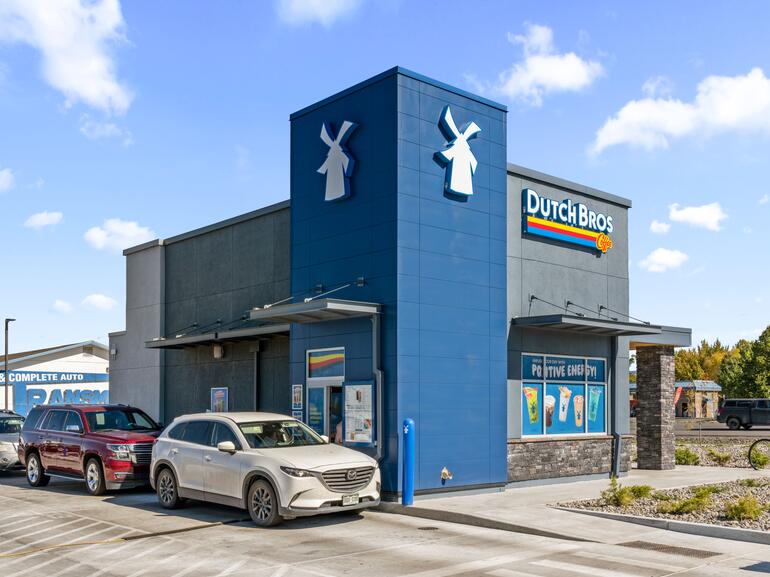
Dutch Bros | 7 Brew | Take 5
These concepts are expanding quickly and gaining market share, drawing a wider pool of institutional investors. Cap rates have been compressing roughly 3 to 5 basis points per quarter as buyers become more comfortable with the growth story.
The brand is not the underwrite
Two properties occupied by the same tenant can have very different investment profiles once you look at the market, the real estate and the performance of the individual store.
When I'm comparing locations, three things tend to separate the assets that draw the strongest demand.
- Start with the market
Population and income growth matter, along with retail spending and the overall trajectory of the trade area. I'm particularly interested in high-growth markets and corridors where the surrounding fundamentals give the real estate room to become more valuable over the course of the hold. - Then look at the real estate
Within the same market, location quality can vary considerably. Dense retail trade areas, visibility, easy access and proximity to strong anchors all influence how investors view an asset. The building itself matters, too. A functional property that could accommodate another user gives an owner more options if the original investment thesis changes. - Get closer to the store
This becomes especially important with franchisee-operated concepts. Store-level sales and the financial health of the franchisee can tell you much more than the growth story of the broader brand. A retailer can open dozens of locations in a year without every one of those stores performing at the same level.
What do I look at first?
After the rent roll, one of the first things I look at is rent relative to market.
Below-market rent in a strong trade area immediately gets my attention. It provides room for future rent growth, and a functional building in a desirable location offers flexibility if circumstances change during the hold.
Big-box deserves another look
Big-box retail still carries baggage from the wave of bankruptcies and closures that took out names including Bed Bath & Beyond, Tuesday Morning, Big Lots and Party City. Those headlines understandably made investors more cautious about the category, and that caution continues to influence pricing.
Well-located big boxes are increasingly difficult to reproduce, particularly in established retail corridors where land is scarce and construction costs have changed the economics of new development. Many existing properties also carry rents well below what would be required to justify building comparable space today.
We're seeing expanding retailers take advantage of that equation. Burlington, TJX, Trader Joe's and Aldi have all absorbed second-generation space, giving landlords a deeper pool of potential users for boxes that investors once viewed as difficult to backfill.
Why I'm watching big-box
- Low rents
- Limited new supply
- Scarce infill sites
- Growing tenant pool
- 6.5%–8% cap rates
Existing big-box properties can combine rents that are difficult to replicate with locations that have become increasingly difficult to build. We're seeing opportunities trade in roughly the 6.5% to 8% cap rate range, depending on the tenant, lease structure and underlying real estate.
In practice: Looking beyond the bankruptcy headline
A portfolio of At Home properties we're currently working on offers a good example of how this approach plays out in a real transaction. At Home emerged from Chapter 11 last year following a significant restructuring, which could easily put the credit in the penalty box for investors screening opportunities primarily by tenant history.
Rents across these properties are below $6 per square foot, the stores sit in strong trade areas and the investor is acquiring them at approximately $100 per square foot. Several locations also offer the potential to develop outparcels, creating another source of value within the investment.
At that basis, the investor is getting below-market rent, strong locations and additional development potential in properties that would cost several times more to recreate today.
Where the playbook goes next
I'm spending more time looking at where retailers are gaining market share, what they're doing with their store footprints and how individual locations fit within those growth plans. At the property level, rent relative to market, trade-area quality, store-level performance, replacement cost and the ability to reuse the real estate all factor into how I think about the durability of an investment.
There will always be deep demand for the strongest, most established credits. I'm equally interested in the opportunities that require a little more work to recognize, particularly when the real estate and economics support a story the market hasn't fully priced yet.
Get the report



Insights
Research to help you make knowledgeable investment decisions