
Economic commentary: Slowing growth and the case for rate cuts
The important economic reports issued in July were compressed into the final week of the month. What started out as a rather routine week with the Fed announcing no change in the Federal Funds rate, as expected, ended with a surprisingly weak Employment report that has the potential to change the discussion around the timing and degree of interest rate easing in the coming months. In between those two events, we also had the June reading on the Fed’s preferred inflation metric, the first estimate of real GDP in the second quarter, and the June report on personal income and spending. And, of course, there were ongoing tariff announcements to be considered, as well.
Inflation pressures
Looking first at inflation, the Consumer Price Index (CPI) rose 0.3% in June, in line with expectations. The year-over-year reading is 2.7%, up from 2.4% due to weak readings in the summer of 2024. The readings for the core CPI (ex-food and energy costs) came in slightly below expectations at +0.2%, bringing the year-over-year core reading to 2.9% from 2.8% previously, again due to depressed readings in 2024. There have now been five consecutive months where the core readings were 0.2% or less. The impact of tariffs is starting to be seen in the pricing of goods, but softer pricing in the service sector is providing some counterbalance to the impact of tariffs.
The Fed prefers to focus on the Core Personal Consumption Expenditure Index (Core PCE) for inflation readings. The Core PCE was +0.3% in June – the fastest pace since February – bringing the year-over-year reading to 2.8%, unchanged from May. From the Fed’s viewpoint, bringing inflation back to its target of 2% remains a challenge, especially with the unknown extent of price hikes ahead from tariffs and how sustainable they will be.
Consumer spending stalls amid rising financial strain
While the progress on inflation appears to have stalled due to uncertainty around the impact from tariffs, consumer spending is slowing, resulting in a slowdown in overall economic activity. Real disposable personal income was unchanged in June and is only growing at 1.7% year-over-year. Real personal consumption expenditures (consumer spending) only grew +0.1% in June and 2.1% year-over-year. Importantly, real consumer spending has been flat since December. The slowing growth rate of real disposable income is resulting in a slowing growth rate of real consumer spending, which leads to slower real GDP growth since the consumer accounts for 70% of GDP. As mentioned last month, growing consumer strain is evident via various metrics on delinquencies, credit card balances and ability to make minimum credit card payments. This financial stress is moving up the income ladder with those making at least $150,000 annually seeing past-due debts rising faster than those for lower- and middle-income households.
The initial estimate of second quarter real GDP is +3.0% (annualized), a reversal from the -0.5% reading of the first quarter. However, the readings for both quarters are distorted due to the tariffs. Strong imports reduced GDP growth in the first quarter, but that was reversed in the second quarter. Consequently, a better way to assess real GDP growth is to look at the full six-month period. For the first six months of 2025, real GDP grew at 1.2% (annualized), down from 2.8% growth in 2024. Real Final Sales to Domestic Purchasers – which excludes exports, imports and inventory changes – is a better gauge of underlying economic momentum and only grew at a 1.2% annualized rate in the second quarter. This metric has been steadily declining over the past year, going from 3.4% in third quarter 2024 to 2.9% in fourth quarter 2024. In first quarter 2025, it declined further to 1.9% and in second quarter, dropped to 1.2%. The economy continues to slow, and these low levels of growth make the economy more and more susceptible to extraneous shocks that may occur.
Manufacturing contraction deepens
The ISM Manufacturing Index for July indicated that the manufacturing sector contracted for the fifth consecutive month with a 48.0 reading, a nine-month low (readings below 50 indicate contraction). Only seven out of 18 industries reported any growth, the lowest number since November. New Orders, Backlog of Orders and New Export Orders all continue to contract. Notably, the employment sub-index was the primary source of weakness, dropping to its lowest reading since June 2020. Many respondents to the survey noted that tariffs are impacting most aspects of their businesses.
Employment weakens with revisions and rising unemployment
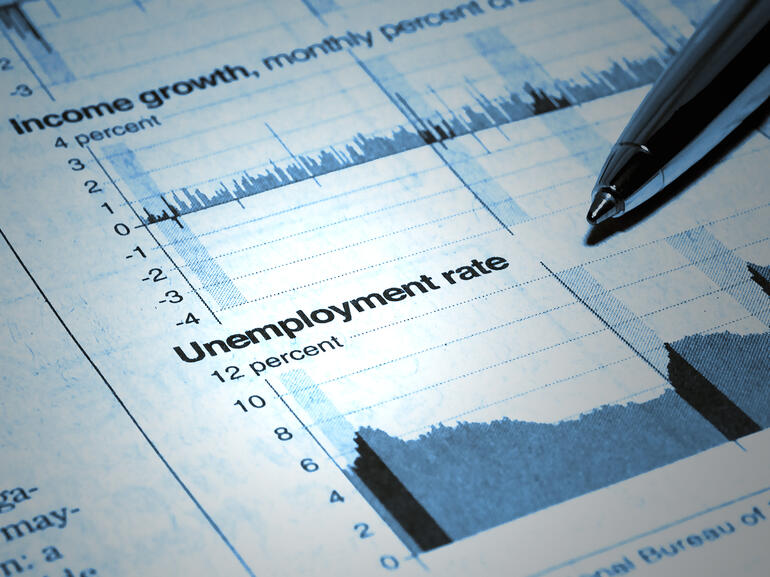
Undoubtedly, the report receiving the most attention is the weak Employment report for July. Non-farm payrolls rose by 73,000, below expectations of 104,000. The 73,000 increase was entirely due to a 55,000 gain in healthcare jobs and an 18,000 increase in social assistance jobs. But the big story was the huge revisions to May and June by a total of 258,000. The three-month average employment gain (May to July) is now 35,000, the lowest three-month average since June 2020.
Private sector jobs were also revised sharply lower in May and June by a combined 139,000. The unemployment rate rose to 4.2% from 4.1% in June due to a decline in the labor force of 38,000, a drop in the number employed of 260,000 and an increase in the number unemployed of 222,000. The unemployment rate is expected to move higher over the coming months, but the slower labor force growth due to immigration constraints will likely keep the unemployment rate from rising sharply.
The cracks in the employment picture that had been developing over the past several months have now opened wider with this report and the revisions to prior reports. One report does not make a trend, however, and the Fed will have one more employment report before their next meeting on September 16-17. For now, however, the discussion on when to lower interest rates has been moved to support sooner action. Prior to the release of the employment report, there was a 40% chance that rates would be lowered at the September meeting. That percentage is now 87%.
The Fed’s balancing act
The Fed’s recent meeting on July 29-30 is almost an afterthought now, given the Employment report. At that meeting of the Federal Open Market Committee (FOMC), it was decided to hold the target range for Fed Funds steady between 4.25% and 4.50%, as expected. In the statement after the meeting, the FOMC said that “growth of economic activity moderated in the first half of the year,” but maintains “labor market conditions remain solid” and inflation “remains somewhat elevated.”
Of note, Fed Governors Christopher Waller and Michelle Bowman voted against the decision to hold rates steady in favor of lowering rates by a quarter point, the first time two members of the Fed board have dissented since 1993.
The Fed’s job just got even more challenging as they must consider the concurrent impacts of a softer jobs market, slower consumer spending and unknown tariff impacts on both consumer incomes and corporate profits. Although not a policy setting meeting, the upcoming meeting at Jackson Hole, Wyoming on August 21-23, will provide Chair Powell with the opportunity to express thoughts on monetary policy given these challenges.
Get the report

Insights
Research to help you make knowledgeable investment decisions