
Tucson multifamily rents push higher as vacancy tightens
Q3 2026
Download the full Q3 2026 Tucson multifamily market report here.
Highlights:
- Multifamily operating conditions in Tucson strengthened during the third quarter, supported by continued vacancy improvement and rent growth.
- The vacancy rate declined by 50 basis points during the past three months to 7.2%, building on improvements recorded during the first half of this year. Vacancy is down 160 basis points from one year ago, with declines recorded across nearly all submarkets.
- Average rents increased 1.2% during the third quarter to $1,163 per month. The Tucson market is on pace for its first year of positive rent growth since 2023.
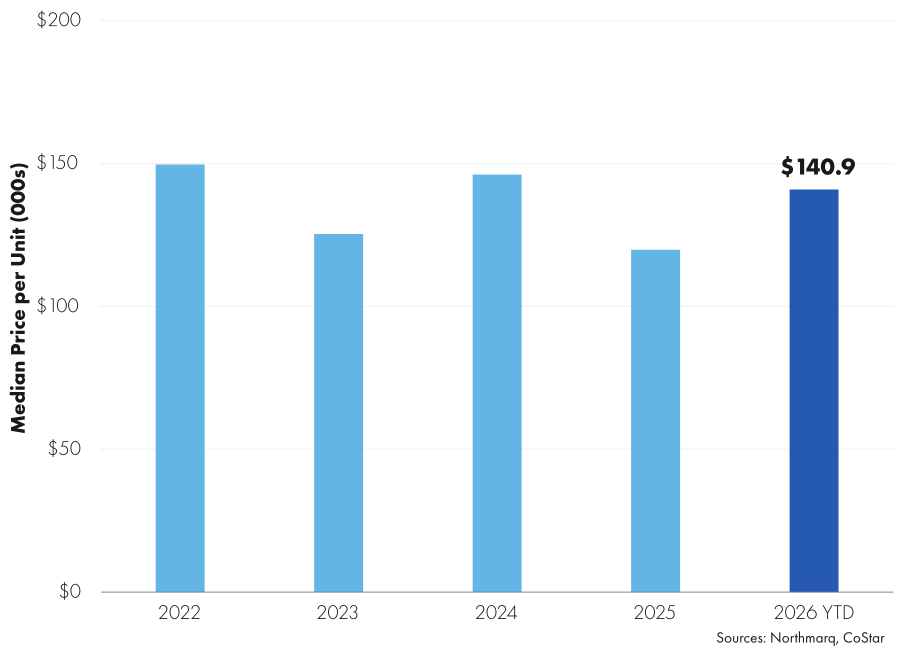
- Multifamily sales velocity has closely tracked 2025 levels to this point in 2026, with increases in larger sales being offset by declines in smaller transactions. The median sale price was $140,900 per unit, while cap rates have averaged 6.1%.
Tucson multifamily market overview
Operating conditions in the Tucson multifamily market continued to stabilize during the third quarter, highlighted by tightening vacancy conditions. After a steep decline was recorded in the second quarter, the vacancy rate improved again during the past three months. At just 7.2%, current vacancies are at their lowest levels since the second half of 2022. Recent improvement has occurred throughout nearly all of Tucson’s submarkets, with the northern portions of the metro generally tightening faster than the rest of the market. The Northwest Tucson, Oro Valley, and Marana submarkets have all posted year-over-year vacancy declines of 250 basis points or more as of the third quarter. As the vacancy rate has trended lower, rents have begun to gain traction. Rents have ticked higher in each quarter this year, and annual rent growth turned positive for the first time since early 2024 during the third quarter.
While property fundamentals have begun to gain momentum in recent quarters, the Tucson investment market has lagged behind. Sales activity remains steady but light, with transaction levels through the first nine months of the year closely tracking the low levels recorded during the same period in 2025. Still, there have been some shifts in the transaction mix. The average transaction size has trended higher, fueled by an increase in larger deals. More transactions of $25 million or more closed in the first nine months of this year than during all of 2025. These larger trades are occurring while there has been a sharp decline in sales below $10 million. While operating fundamentals have improved across much of the market, the largest transactions have generally been concentrated in East Tucson, along the Speedway and Broadway Boulevard corridors.
Employment:
During the past 12 months, employers grew payrolls by 0.5%.
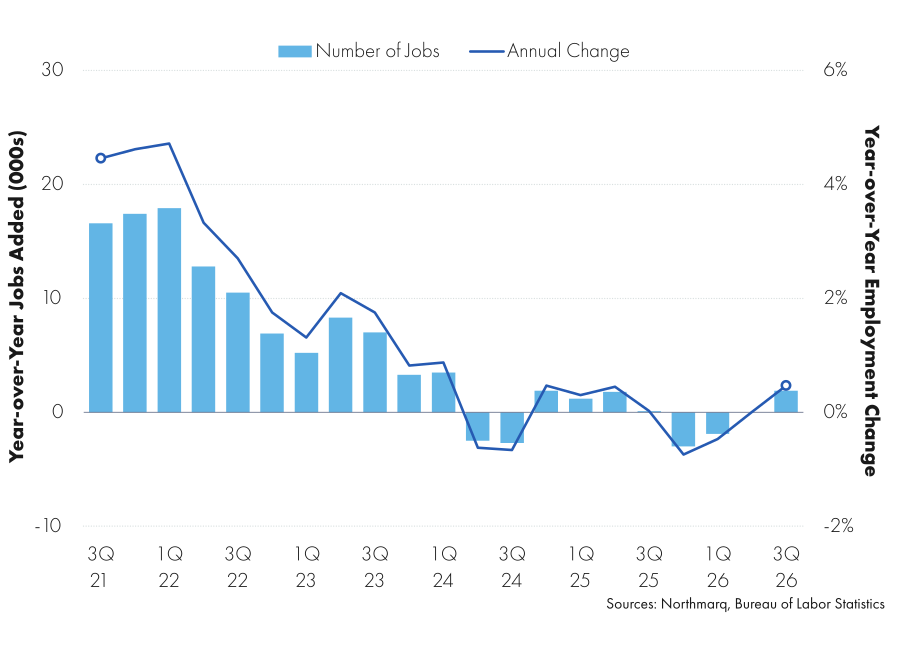
- Employment growth has picked up in recent months following declines earlier in the year. During the past 12 months, Tucson employers grew payrolls by 0.5%, adding 1,900 workers.
- Education and health services has been a leading sector for job growth over the past several periods. Year over year, area employment in the sector expanded by 3.4%, with the addition of 2,500 jobs.
- Late in the third quarter, Raytheon was awarded a $20.7-billion federal contract for new missile production. The contract is expected to support continued hiring across the company’s Tucson operations, which currently total nearly 15,000 workers.
- Forecast: Employers in the Tucson areas are forecast to add 2,000 workers in 2026, a 0.5% annual increase. These gains will partially offset net job losses that occurred in 2025.
Development and permitting:
Year to date, 545 units have come online.
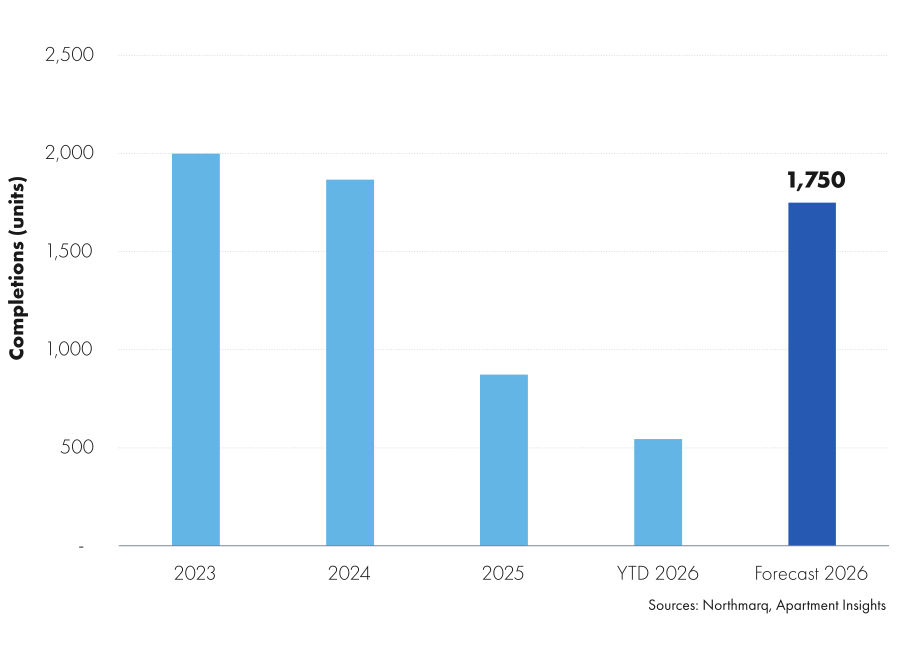
- Construction activity is ahead of the 2025 pace. Developers completed projects totaling 545 units through the first three quarters of this year, up 34% from the same period in 2025.
- As new projects have come online, the construction pipeline has thinned. Approximately 2,500 units are currently under construction throughout the Tucson market, the lowest figure since the second quarter of 2022.
- Developers have pulled permits for approximately 580 multifamily units through the first three quarters of this year, up 26% from levels during the same period in 2025. Multifamily permitting peaked in 2022, and has generally trended lower in subsequent years.
- Forecast: More units are on pace to deliver in the fourth quarter than have come online through the first nine months of the year. Projects totaling approximately 1,750 units are expected to be completed in 2026, nearly doubling the completions total for last year.
Vacancy:
Vacancy declined in 13 of Tucson’s 15 submarkets.
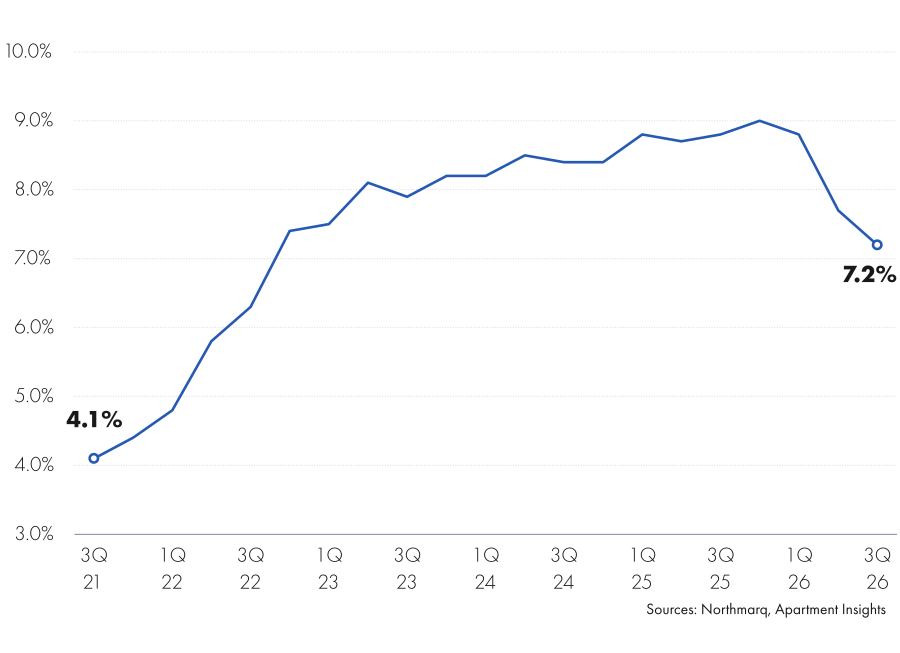
- The vacancy rate in Tucson improved by 50 basis points in the third quarter to 7.2%. This marked the third consecutive quarter where vacancy tightened after mostly flat conditions throughout much of 2025. Year over year, vacancy is down 160 basis points.
- During the past 12 months, vacancy declined in 13 of Tucson’s 15 submarkets. The Southeast Tucson submarket has the lowest average vacancy rate in the market, at 3.5%, after averaging over 8% since the beginning of 2023.
- Net absorption totaled approximately 430 units during the third quarter, after topping 1,700 units in the first half of 2026. To this point in 2026, net absorption in the Northwest Tucson submarket has reached more than 460 units, the highest total of any submarket in the Tucson area.
- Forecast: After posting significant improvements throughout much of 2026, area vacancies are expected to inch higher in the coming months. The rate is forecast to end the year at 7.4%, 160 basis points lower than at the end of 2025. Area vacancies have not ended a year below 8% since 2022.
Rents:
Current rents are up 2.9% year to date.
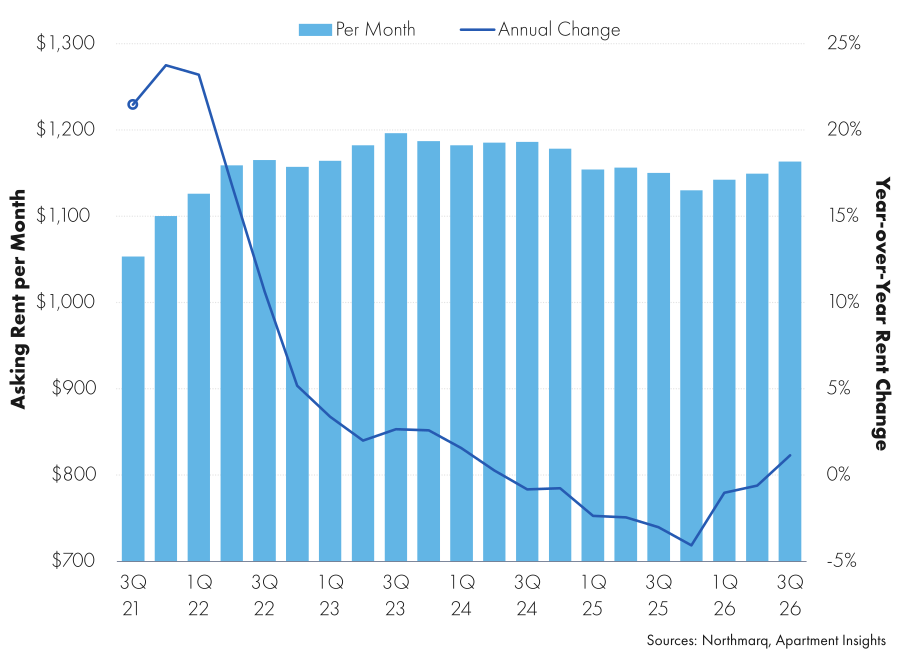
- Average rents increased 1.2% to $1,163 per month during the third quarter. Rents have increased in each quarter in 2026, after posting quarterly declines in three of the four periods in 2025.
- Current rents in Tucson are up 2.9% year to date, but are only 1.1% higher than levels from one year ago. The Class B segment has posted the market’s strongest rent growth in recent periods.
- Despite overall gains across the metro area, there are still segments of the market where rents are falling. Average rents in the North Central Tucson submarket have contracted by 4.1% year over year, while rents in the South Tucson/Airport area have dropped by 3.3%. Both of these submarkets have maintained higher vacancies than the market average in each of the past five quarters.
- Forecast: Rents are expected to tick lower in the final few months of 2026, but the market is positioned to record its first calendar year of positive rent growth since 2023. Rents are forecast to end 2026 at $1,160 per month, a 2.7% annual increase.
Multifamily sales:
The median sale price is $140,900 per unit.
- Multifamily investment activity in Tucson held steady during the third quarter, with a few properties trading, matching the transaction count from the previous quarter. Through the first nine months of 2026, sales activity was unchanged from the same period in 2025.
- Pricing trends have moved higher in 2026. Year to date, the median sale price is $140,900 per unit, up 11% from year-ago levels.
- Cap rates have remained relatively stable in 2026, averaging 6.1%. Cap rates averaged in the mid-5% range for more than a year before pushing higher in recent periods.
- Pricing has rebounded from the recent low recorded in 2025 but remains below levels reached in 2022 and 2024.
Looking ahead for Tucson:
Property fundamentals have gained significant ground through the first three quarters of 2026, although some softening is expected to close out the year. Vacancy in Tucson has increased during the fourth quarter in each of the past five years and a similar result is expected this year. A seasonal demand slowdown will be occurring as the bulk of this year’s new inventory comes online. The combination of additional inventory and more modest renter demand should weigh on operating conditions in the near term. Vacancy is expected to tick higher, while rents could post a slight quarterly decline. Still, recent improvements should keep rents on track to finish this year higher than year-end 2025 levels, marking the market’s first year of rent growth since 2023.
Multifamily transaction activity has remained limited through the first three quarters of 2026, and that trend is expected to continue in the coming months. One factor having a particular impact on investment volumes has been a decline in the number of sales under $10 million. These smaller transactions have accounted for more than half of the market’s total transactions since 2015. Year to date in 2026, however, transactions in this size range have made up less than 25% of deals. A higher interest rate environment is expected to continue to restrict activity in these transaction ranges, even if cap rates remain on their current trajectory and inch higher. These forces may continue to keep overall sales activity below historical levels.
Connect with our Phoenix team today
For a complete analysis of supply, demand, vacancy, rent and investment trends in the Tucson multifamily market, download and read the full report below. Subscribe to receive the latest multifamily market insights and research.
The Northmarq Phoenix office provides a broad range of commercial real estate solutions across debt, equity and investment sales. Engage with our Phoenix team today.
Get the Q3 2026 Tucson report


Insights
Research to help you make knowledgeable investment decisions