
Why Walmart wants you to believe in drone delivery
By Bryn Feller, managing director of commercial investment sales
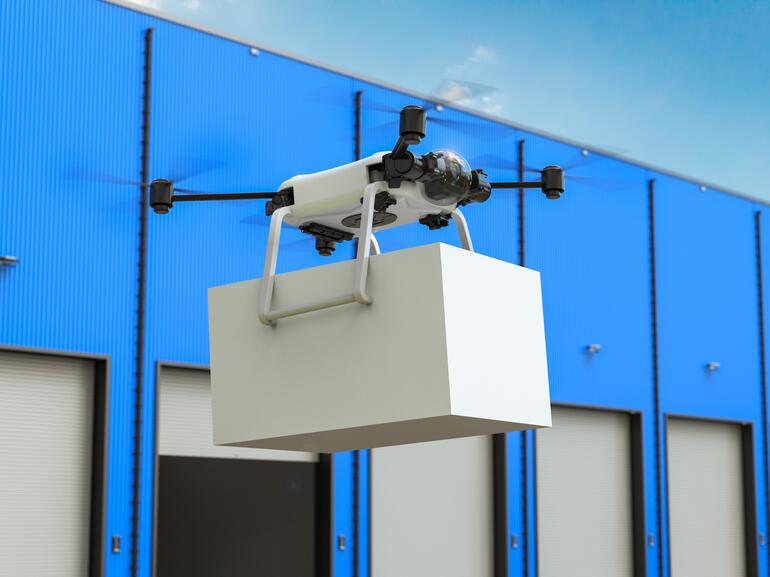
Walmart’s bold announcement—drone delivery reaching 75% of the Dallas–Fort Worth metro—grabbed headlines. But here’s the reality: it’s currently available at fewer than 2% of Walmart stores in the U.S, and in terms of true logistics scale, remains a rounding error.
At this stage, drone delivery costs around $13.50 per package, compared to roughly $1.90 via ground van, according to McKinsey. While improvements in monitoring and automation are projected to bring that below $3, the cost per delivery is still too high to make financial sense.
And it’s not just Walmart. While Google’s Wing and Amazon Prime Air are also piloting drone programs, Target has notably stayed on the sidelines, focusing instead on bolstering its conventional and in-store pickup networks.
So why is Walmart making such a public splash?
Because narrative is infrastructure in today’s market. In a fast-paced, media-driven environment, a compelling story can shape consumer perceptions, guide investor expectations, and even set industry trends long before products or services fully mature.
With inflation pressure, consumer caution, DEI debates, and Amazon’s dominance commanding the headlines, big-box retailers are desperate for optimistic stories. Drone delivery serves as a beacon of innovation—an antidote to a sea of negative sentiment.
The last decade has erased the boundary between e-commerce and brick-and-mortar. Retail now lives and dies in the omni-channel battleground, where speed, convenience, and brand perception are equally vital. In that arena, drones serve as powerful symbols—not transformative logistics tools.
That said, drones aren’t going away. Picture this: a drone dropping off your child’s fever medicine in minutes, no traffic, no waiting — it’s a glimpse of a future that feels almost cinematic. That’s the story Walmart is selling, even if the reality isn’t quite there yet. But the territorial risks remain considerable: hefty upfront costs, zoning uncertainty, labor and FAA regulations, and limited payload and weather constraints.
For commercial real estate and investment professionals, the sharpened question is: where will the real margin unlocks come from?
The answers are likely in low-tech but high-impact areas: optimizing supply chain logistics, redeploying existing stores as micro-fulfillment centers, and automating labor in distribution hubs. Those are where scale meets substance—and where real core profit is won.
Walmart’s drone move isn’t a mass-market game changer yet. It moves the narrative, showcasing innovation, but the margin game will be won in real estate, site strategy, and scalable logistics, not drone flights.
Related Contacts

Northmarq is one of the largest privately held commercial real estate firms in the United States, combining a nationwide presence with deep local expertise. With more than 50 offices across the country, we provide a full suite of debt, equity, investment sales, loan servicing and fund management solutions for a comprehensive range of property types. Our unique structure allows us to connect clients with the best opportunities, yet be nimble enough to ensure access to every expert across our company. The firm manages a loan servicing portfolio of over $80 billion and has completed $91.3 billion in transactions over the past four years. At Northmarq, collaboration fuels results, helping clients achieve success in every market, nationwide.