
Washington, D.C. multifamily sales volume surpasses 2025 total
Q3 2026

Download the full Q3 2026 Washington, D.C. report here.
Highlights
- Operating conditions in the Washington, D.C., region were mixed in the third quarter as annual job losses narrowed for a second straight quarter and new deliveries slowed. Permitting reached its highest year-to-date level since 2022.
- Regional vacancy declined 10 basis points during the third quarter to 5.7%, the first quarterly decline in more than a year, though it remains 60 basis points above one year ago. Vacancy in the District and Suburban Maryland has eased for two straight quarters.
- Asking rents were unchanged from the second quarter at $2,233 per month but remain down 0.8% year over year. Northern Virginia rents were nearly flat from a year ago, and the decline in Class A rents has narrowed.
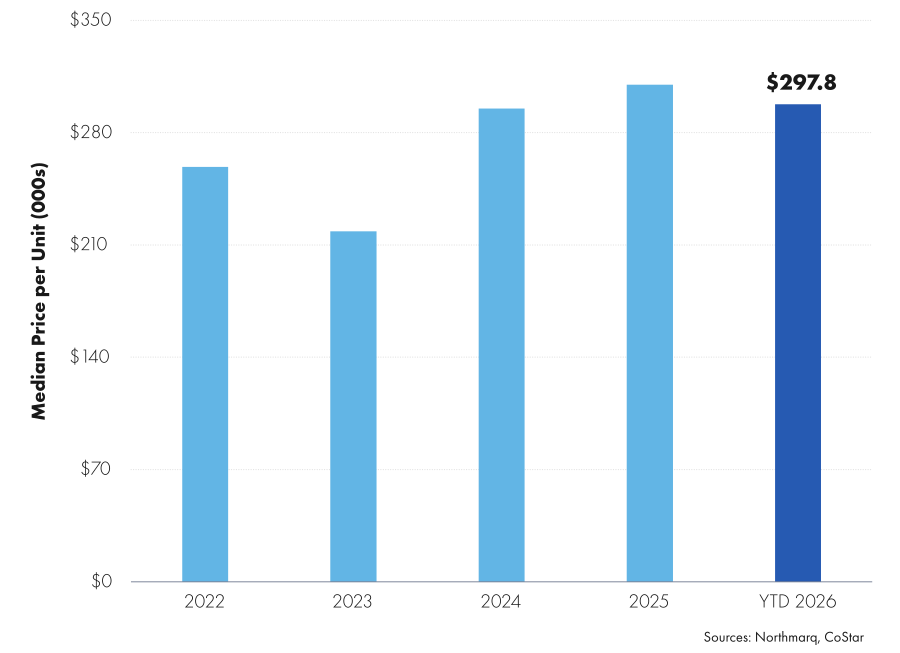
- Investment activity strengthened in the third quarter, with 16 properties trading for $1.8 billion, pushing year-to-date volume above the 2025 total. The year-to-date median sale price is $297,800 per unit.
Washington, D.C. multifamily market overview
The Washington, D.C., multifamily market showed further signs of stabilization in the third quarter as a slower pace of new deliveries coincided with easing employment losses. Vacancy declined for the first time in more than a year, although the improvement has yet to translate into rent growth. Northern Virginia continued to record the region's tightest vacancies and more stable rents, while the District and Suburban Maryland posted a second consecutive quarter of declining vacancy. Performance also varied across property classes, with Class A vacancy retreating and rent declines moderating, while Class C vacancy continued to rise. These trends point to a gradual improvement in operating conditions, though ongoing employment losses and uneven property performance continue to limit the recovery.
Investment activity continued to strengthen across the Washington, D.C., region in the third quarter, with Fairfax County accounting for much of the increase in sales volume. Earlier in the year, transactions in Fairfax were concentrated in newer apartment communities, but activity shifted toward older Class B and Class C properties in the third quarter. These properties accounted for roughly three-quarters of the county's quarterly dollar volume. While sales volume in Fairfax remained near first-quarter levels, the county's median price declined from approximately $418,000 to $305,000 per unit. This decline largely reflects the changing mix of properties sold rather than evidence of a broader reduction in property values.
Employment:
Annual job losses eased for a second straight quarter.
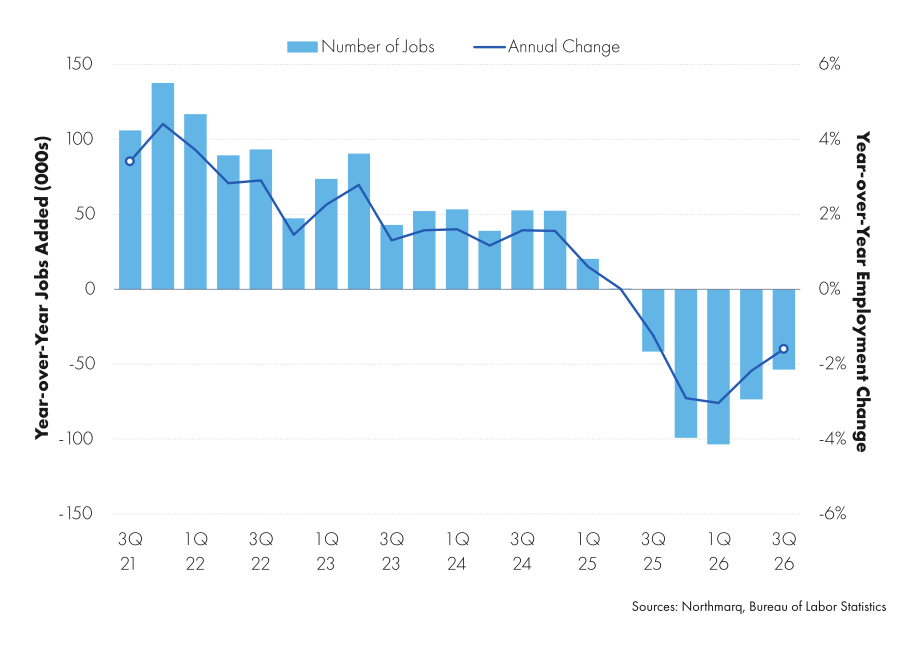
- The region continues to post net job losses, although the deepest cuts have already occurred an conditions have begun to stabilize in recent periods. During the past 12 months, total employment has contracted by 1.6% with losses totaling more than 50,000.
- Federally linked sectors remained the largest drag on employment in the third quarter. Government payrolls were down 30,600 positions year over year, a 4.4% decline, while professional and business services, the federal contractor base, was down 16,700 positions, or 2.1%, roughly half the annual loss recorded in the first quarter.
- In Suburban Maryland, AI platform company Cloudforce announced an expansion of its National Harbor headquarters in August, with plans to add 250 jobs.
- Forecast: Regional employment is projected to decline by roughly 10,000 jobs in 2026, a 0.3% contraction, compared with a 10-year average annual gain of 0.5%.
Development and Permitting:
Year-to-date completions totaled roughly 7,600 units.
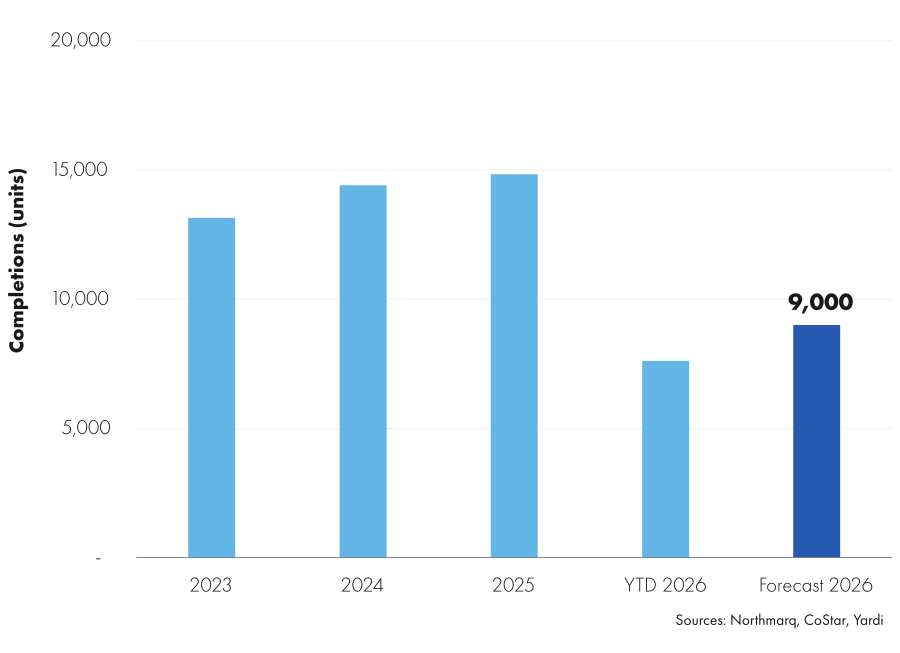
- Developers completed roughly 2,500 units in the third quarter, about 30% below the quarterly average of 2025. Suburban Maryland accounted for roughly 1,200 of those units, followed by Northern Virginia at around 900 units and the District at approximately 450 units.
- Nearly 16,000 units are under construction, with Northern Virginia containing roughly 8,800 units, more than the District and Suburban Maryland combined.
- Developers pulled permits for 10,200 multifamily units year to date, surpassing new deliveries for the first time since 2022.
- Forecast: Regional deliveries are projected to total roughly 9,000 units in 2026, about 20% below the 10-year average.
Vacancy:
The vacancy rate ended the third quarter at 5.7%.
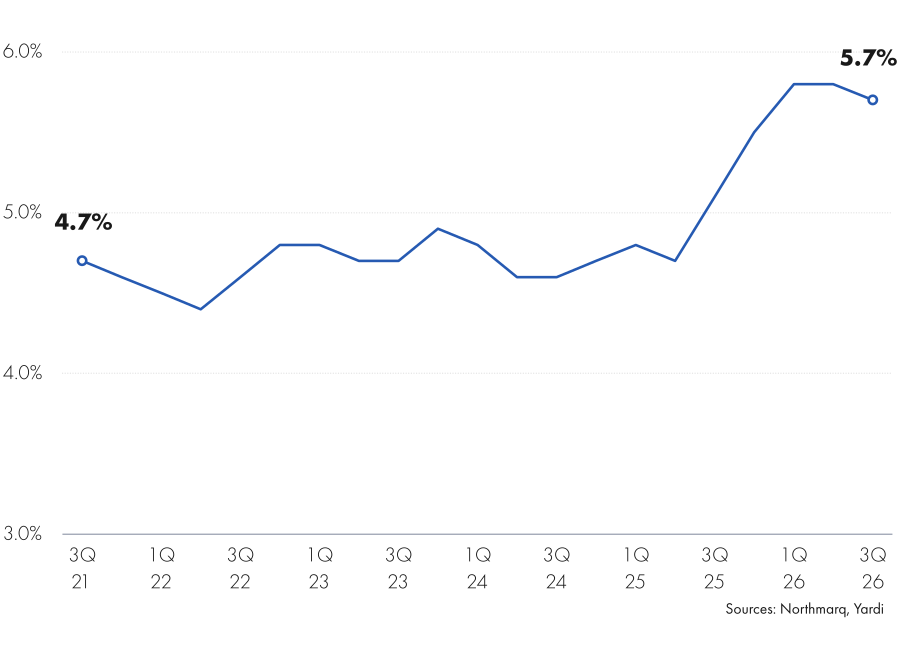
- Regional vacancy fell 10 basis points during the third quarter to 5.7%, the first quarterly decline in more than a year, but remains 60 basis points above one year ago. The pullback came as deliveries ran below the 2025 pace and annual job losses narrowed.
- Northern Virginia remained the tighter subregion at 4.7%, though vacancy is up 70 basis points over the past year. Vacancy in the District and Suburban Maryland has eased for two straight quarters to 6.5%, down from the first-quarter peak of 6.7%.
- Class A vacancy remained the tightest segment at 5.1%, while Class C had the highest vacancy rate at 7.2%, up 110 basis points year over year. Class C vacancy has risen for eight consecutive quarters, while Class A has eased for two.
- Forecast: Regional vacancy is projected to reach 5.8% by year-end 2026, 30 basis points above the level recorded at the end of 2025.
Rents:
Regional asking rents are down 0.8% year over year.
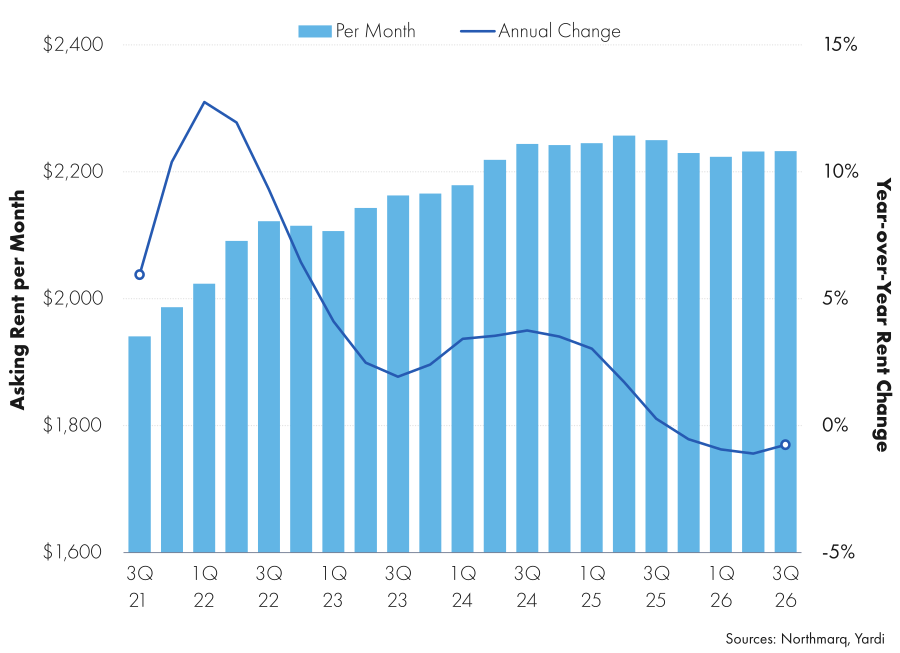
- Regional asking rents ended the third quarter at $2,233 per month, unchanged from the second quarter and up just 0.1% year to date. Rents have fallen year over year for the fourth consecutive quarter, though the pace of decline has eased.
- Northern Virginia rents fell 0.4% year over year to $2,341 per month, while rents in the District and Suburban Maryland declined 1.5% to $2,147 per month. Northern Virginia has outperformed the rest of the region for two consecutive quarters.
- Class A rents remained the weakest, falling 1.2% year over year, though the decline has narrowed from 1.8% in the second quarter. Class B and Class C rents decreased 0.9% and 0.5%, respectively.
- Forecast: Regional asking rents are projected to reach $2,235 per month by year-end 2026, up 0.2% from 2025.
Multifamily Sales:
The year-to-date median sale price was $297,800 per unit.
Looking ahead for Washington, D.C.
Annual job losses should ease further as the steep declines of late 2025 roll out of the comparison, but payrolls themselves are expected to stay roughly flat, and federal workforce decisions made at the start of the fiscal year in October remain the main risk. Supply offers firmer support. Deliveries are set to fall well below the pace of the past three years, and the current schedule for 2027 is lighter still, though rising permits point to a rebuilding pipeline beyond that. Northern Virginia, which contains most of the remaining construction pipeline, will receive most of that new supply. Vacancy has risen in the fourth quarter of each of the past four years, so a small seasonal uptick is expected, and rents should finish the year close to where they began.
Sales volume needs only a fourth quarter modestly above last year’s performance to make 2026 the strongest year for sales since 2022. Trades of $100 million or more account for about three-quarters of year-to-date volume, and most of them occurred in Northern Virginia, so quarterly totals are likely to stay uneven even if the annual pace holds, with a single large trade able to shift a quarter’s totals. How broad the recovery in transactions becomes will depend on the District and Suburban Maryland, where trades are of smaller and older assets and where vacancy has eased for two straight quarters, but rents are still falling. Class A pricing has been steady, which gives the market a stable reference point even as the median sale price moves with the mix of trades.
Connect with our Washington, D.C. team today
For a complete analysis of supply, demand, vacancy, rent and investment trends in the Washington, D.C. multifamily market, download and read the full report below. Subscribe to receive the latest multifamily market insights and research.
The Northmarq Washington, D.C. offices provide a broad range of commercial real estate solutions across debt, equity and investment sales. Engage with our 13th Street and Wisconsin Avenue Washington D.C. teams today.
Get the Q3 2026 Washington, D.C. report


Insights
Research to help you make knowledgeable investment decisions